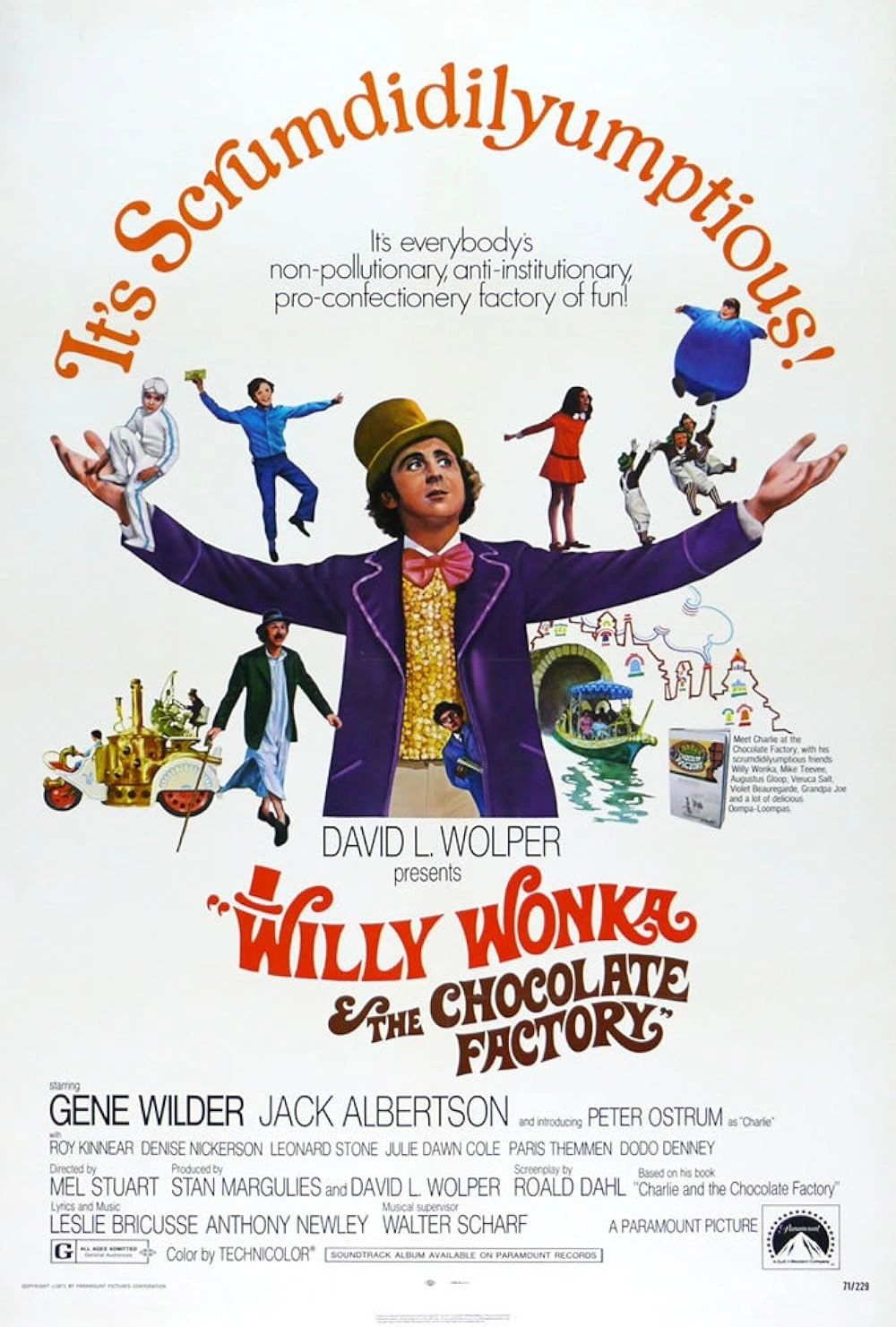
Willy Wonka and the Chocolate Factory might look like a sugar rush on the surface, but bite down and you will find something sharper underneath. Beneath the bright sets and whimsical songs lies a streak of dark humor, a moral severity, and an unpredictable energy that turns what could have been a simple family musical into something stranger and far more enduring. This is not the neat, sanitized world of a Disney fairy tale. It is closer to a Brothers Grimm fable, where the rewards are hard earned, the consequences are severe, and the storyteller seems to enjoy unsettling you.
When the film first arrived in 1971, audiences were unsure what to make of it. It earned a modest $4 million on a $3 million budget, critics gave it a lukewarm reception, and Roald Dahl, whose book it adapted, was openly displeased with the way the focus shifted from Charlie to Willy Wonka. For several years it floated in cultural limbo, lacking the kind of warm public embrace that turns a movie into an instant classic. Paramount, the original distributor, even declined to renew its rights. It was only when Warner Brothers acquired the film and began selling it to television networks that its second life began. Repeated TV airings in the 1980s and the explosion of home video made it a fixture in households, and by the 1990s, it had become a beloved part of pop culture.
One of the reasons it found a later audience is that it plays against expectations. On the surface, it is a family musical with colorful characters and catchy tunes. In reality, it is a sly satire of that very type of movie. The early “Candyman” sequence, with its sunny lyrics and candy shop charm, is quickly undercut by Charlie’s meeting with a mysterious Tinker who quotes an old Irish poem about “little men” and warns that no one ever comes out of the factory. The effect is jarring and deliberate, hinting at the surreal, slightly dangerous atmosphere that will dominate every scene involving Wonka.
Gene Wilder’s performance is the cornerstone of that tone. He insisted on an entrance where Wonka hobbles toward the crowd with a cane, then drops it and performs a sudden somersault. From that moment on, the audience is left uncertain whether to view him as a benevolent guide, a master showman, or a man with unsettling motives. His delivery is full of sudden shifts, charming one moment, mocking the next, then veering into what feels like genuine menace. He peppers conversations with poetry and literary quotes, using them both to dazzle and to quietly ridicule the people around him. The famous boat ride is often cited as the film’s strangest moment, but in truth, the entire movie is threaded with that same surreal energy. The ride is simply the most concentrated dose of it.
The children who win the golden tickets are not portrayed as sweet innocents. Each one is an exaggerated embodiment of a flaw such as gluttony, bad manners, entitlement, or obsession with television. The Oompa Loompas’ songs spell out their moral failings with blunt clarity, making the consequences of their actions unmistakable. Even Charlie, the moral center of the story, is tempted into misbehavior. His eventual redemption comes when he chooses to return the Everlasting Gobstopper rather than sell it to Wonka’s rival, an act that defies his own grandfather’s vengeful suggestion. The movie is unafraid to show that even its hero must earn his victory by rejecting selfishness and spite.
This strict moral code, paired with the film’s willingness to punish children for their flaws, may have alienated parents in 1971 who expected a more comforting story. Yet by the time it resurfaced in the 1980s and 1990s, audiences were far more receptive to irony and moral ambiguity. Pop culture had grown accustomed to darker humor, and the movie’s mix of satire, whimsy, and faint menace fit the new cultural mood perfectly.
It is easy to call Willy Wonka and the Chocolate Factory a nostalgic film, but its nostalgia is unusual. Most nostalgia is tied to a specific time and place, as with the 1980s-inspired Stranger Things. Wonka is different. It failed to capture the affection of its own era, yet survived long enough to connect with audiences decades later. Its appeal rests in being slightly ahead of its time, too strange, too sardonic, and too morally severe for the early seventies, yet perfectly suited to viewers raised on a mix of sarcasm and surrealism.
Watching it now, what stands out is how confident it is in its own contradictions. It invites you into a world of candy-colored wonder, then slips in scenes that feel like they wandered in from a psychological thriller. It lets you laugh at the ridiculousness of its characters, then reminds you that actions have consequences. It celebrates imagination, but also warns against selfishness and greed.
Half a century later, Willy Wonka and the Chocolate Factory is still hard to pin down, which may be the secret to its longevity. It is whimsical, but not gentle; moralistic, but never preachy; and sweet, but always with a sharp aftertaste. It is a fable wrapped in a musical, dipped in satire, and sprinkled with just enough danger to keep you wondering whether you should trust the man holding the keys to the chocolate factory.