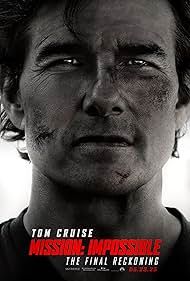
I walked into Mission: Impossible – Dead Reckoning the way a man walks into a bar he’s never been to—aware he’s missed a few fights, but still curious if the whiskey’s worth it.
This was my first Mission: Impossible. I’d never shaken hands with Ethan Hunt, never memorized a self-destructing mission, never gasped at a HALO jump. And yet, I found myself captivated. Not by logic, God no, but by the conviction. This movie doesn’t ask you to believe—it demands it. It looks you in the eye and says, “You’re either in, or you’re boring.”
Was it unrealistic? Of course. It’s the cinematic version of a priest levitating during mass. But when the plane is screaming, the violin score is swelling, and Tom Cruise is sprinting like the soul of Hollywood is on his back—you don’t ask why. You ask, “What happens next?”
Cruise? He sells it. Not as an actor playing a spy, but as a man possessed by the idea of one. Ethan Hunt isn’t just a character anymore. He’s a crusade. And Cruise—well, he’s believable because he has to be. You don’t hang off cliffs at 60 because you’re acting. You do it because you’re chasing something. Maybe redemption. Maybe immortality. Maybe nothing at all.
But he’s not alone in the cockpit. Hayley Atwell slides into the chaos like she was born for it. No wide-eyed rookie routine. No over-explained backstory. Just a thief with nerves of steel and just enough mischief to make the IMF look buttoned-up. She doesn’t orbit Hunt—she collides with him. And the film is better for it.
The airplane scene at the end? That was the exhale. The final note of a song that plays entirely in crescendo. For a moment, gravity felt optional. The stakes were clear. And even if I didn’t know all the players, I knew the game.
The plot? Complicated. Twisty. Built on foundations I hadn’t seen. But it still worked—like watching a chess match without knowing the rules, yet feeling the tension every time a piece moved. You don’t need context when the storytelling has rhythm. And this did. Even if the music sometimes drowned out the melody.
Would I go back and watch the rest? Maybe just the first. The 1996 original. The one with De Palma and shadows and suspicion. I want to see where this madness started—before the stunts took over and the mythos calcified.
But as first brushes go, this wasn’t bad. It wasn’t subtle. It wasn’t grounded. But it was cinema. Big, loud, unapologetic cinema.
And in a world full of safe bets and IP sludge, maybe that’s still something worth showing up for.