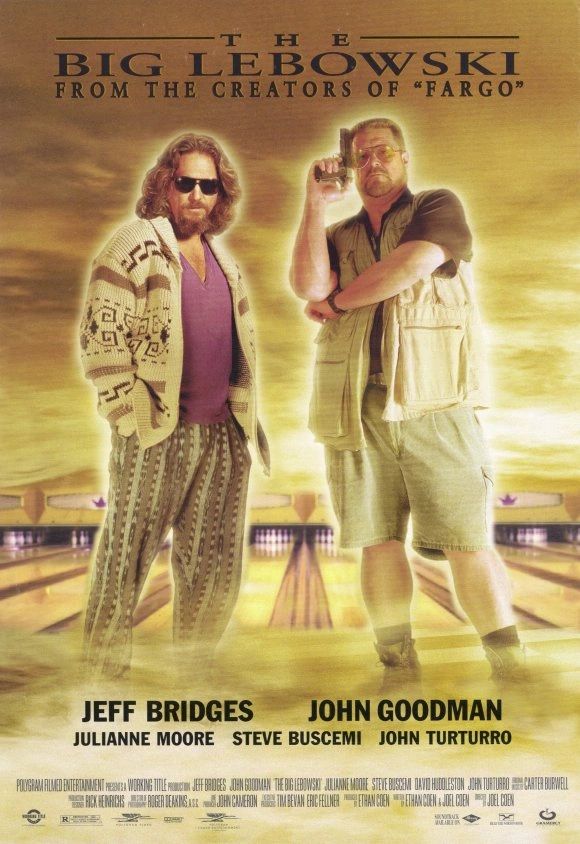
When you first sit down to watch The Big Lebowski, it feels like it is setting you up for a crime thriller. The opening has all the right ingredients: mistaken identity, thugs barging into an apartment, a demand for money, and even a good old-fashioned case of mistaken pee on the wrong rug. It looks like we are about to watch another Fargo-style mystery unravel. But then, something shifts. The plot keeps circling back on itself, introducing stranger and stranger characters, until you realize the crime is not really the point at all. The Coens are playing with you.
That is the beauty of this movie: it is not about solving anything, it is about hanging out in the world the Coens created. If you think of the film as a yarn, it all makes sense. A yarn is not meant to reach a grand conclusion; it is meant to unravel in fun and unexpected ways. That is why the Dude’s quest for a new rug feels so fitting. His life is small, his ambitions are nonexistent, but the comedy comes from watching how that simple goal pulls him into an absurd parade of chaos.
And here is the thing: everyone who watches this movie comes away with their own interpretation. Some people see the Dude as a hero of slacker philosophy, a kind of Zen monk in a bathrobe who has figured out that peace comes from not caring too much. Others argue that the Dude is the perfect critique of American culture in the 1990s. Reaganomics had trained everyone to worship the idea of success and self-made wealth, and then you have the Dude: unemployed, unshaven, and somehow perfectly content.
Walter, of course, throws that balance off. He is all intensity, all rules, all unresolved Vietnam trauma. He wants to control every situation, but he ends up making everything worse. And yet, without Walter, the story does not move forward. He is both the chaos and the engine. The Dude abides, Walter explodes, and we sit there laughing because we know both types of people in our own lives.
But that is not the whole story either. Some fans read deeper layers into the characters. Donny, the quiet bowling buddy who is constantly ignored and eventually dies, has been interpreted as a symbol of how fragile life can be. There is even a theory that Donny is not real at all, just a figment of the Dude and Walter’s imagination, which explains why he is constantly talked over. Whether you buy that or not, it shows how much room the Coens left for interpretation.
Then there are the nihilists. They storm into the movie declaring that nothing matters, yet they care deeply about getting their hands on money. They are a contradiction, but that is the joke. In a film where no one really knows what is going on, the nihilists are the perfect opponents: they stand for meaninglessness but cannot stop chasing meaning.
The setting of Los Angeles plays its own role too. This is not the glamorous Hollywood version of LA; it is bowling alleys, diners, dusty apartments, and strange encounters with eccentric millionaires. If you have lived there, you know that weird moments happen in public all the time, and you just shrug them off. The Coens captured that energy perfectly. When Walter is screaming at Smokey in the bowling alley or melting down in a diner, nobody intervenes. People glance over, get annoyed, and go back to what they are doing. That is Los Angeles in a nutshell.
And here is what makes The Big Lebowski so interesting to revisit: the first time you watch it, you are waiting for the crime mystery to resolve. You expect clues to add up, villains to get caught, and the story to tie itself together. But that never happens. Instead, it pokes fun at the very idea of a mystery plot. It is only on a second or third watch that you can enjoy it for what it is, not what you expect it to be. That is why it bombed with critics and audiences at first but slowly grew into a cult phenomenon.
Now, of course, it is everywhere. Lines like “That’s just, like, your opinion, man” have become cultural shorthand. You do not even need to have seen the movie to know the Dude. People throw on the bathrobe for Halloween or quote Walter yelling “There are rules” when they want to be dramatic about something small. The film escaped its box office failure and became part of the cultural wallpaper.
And that is kind of the point, isn’t it? The Dude abides. He does not fight the current; he just floats along. The more you think about it, the more you realize the movie is not about crime or mystery or even bowling. It is about accepting the chaos of life, letting it spin around you, and somehow finding peace in the middle of it.