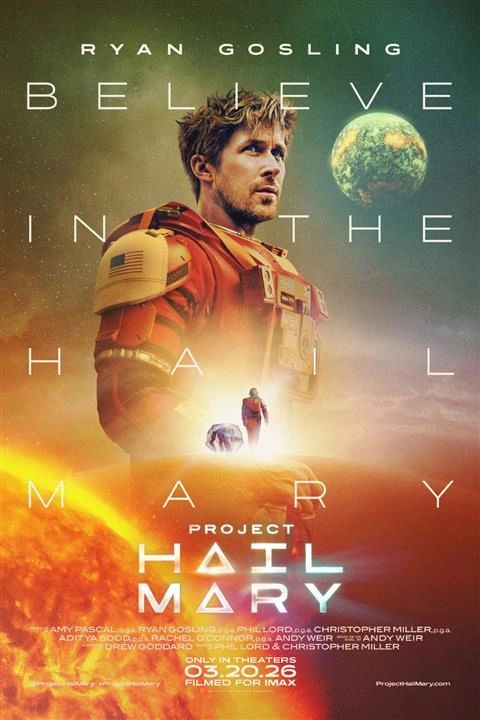
There’s a certain expectation that comes with a sci-fi story adapted from Andy Weir. You expect dense science, high-stakes problem solving, and a protagonist who has to think their way through impossible situations. Project Hail Marydelivers on all of that, but what stood out more was how focused the story felt. Instead of getting lost in the scale of space or the complexity of the mission, the film narrows in on something simpler, a relationship, a choice, and what it actually means to be brave.
At its core, Project Hail Mary is less about the journey through space and more about what happens once Ryland Grace finally isn’t alone anymore. The film wisely doesn’t spend too much time overindulging in the mechanics of the voyage itself. Instead, it moves efficiently toward the central dynamic between Grace and Rocky, which becomes the heartbeat of the story.
That decision mostly works. The pacing feels intentional, never rushed, but also never bogged down by unnecessary detail. Even with a lot of scientific concepts in play, the story remains easy to follow and consistently engaging. There’s always a sense that something is happening, something to solve, something to figure out next.
Where the film does leave you wanting more is in the smaller, quieter moments, especially when it comes to how Grace and Rocky learn to communicate. It’s handled quickly and mostly implied, and while it never feels unbelievable, it does feel like a missed opportunity to deepen one of the most unique aspects of the story. The foundation is there, it just could have been explored a little further.
Still, the core concept lands. Not because it overwhelms you with complexity, but because it stays focused on what matters most.
Ryan Gosling fits naturally into the role of Ryland Grace. His dry humor works well in a story that could have easily taken itself too seriously, and he brings a level of relatability to a character surrounded by complex science and high-stakes decisions. There’s a casualness to his performance that makes Grace feel human, even in the most unfamiliar situations.
That said, this isn’t a performance that carries the movie on its own. The story does most of the heavy lifting, and Gosling’s role is more about facilitating that than elevating it beyond what’s already on the page. He’s consistently good, but never in a way that pulls focus away from the narrative itself.
Where the film really finds its identity is in the dynamic between Grace and Rocky. It’s a unique relationship, not built on traditional emotional beats, but on curiosity, problem-solving, and an almost unexpected compatibility. Rocky, in particular, comes across as a slightly zany presence, different in every way from a human, yet still easy for Grace, and the audience, to connect with.
Their relationship doesn’t necessarily hit with immediate emotional depth. It feels more like a fascinating concept at first, two completely different beings figuring each other out. But as the story progresses, that dynamic evolves into something more meaningful. The emotional weight doesn’t come from how close they feel in every moment, but from what Grace ultimately chooses to do because of that connection.
One of the defining elements of Project Hail Mary is its commitment to science, and for the most part, it strikes a solid balance between complexity and accessibility. There’s a lot happening, from the mechanics of astrophage to the constant problem-solving that drives the story forward, and while not every detail lands perfectly on a first watch, it never feels overwhelming to the point of distraction.
At times, the science can feel dense. There are moments where you might not fully grasp every explanation as it’s happening, especially with how quickly some concepts are introduced. But the film avoids the trap of making the audience feel lost. Even if you miss a detail here or there, you still understand the stakes, the goal, and what needs to happen next.
That clarity is what keeps the tension alive. The movie is constantly moving from one problem to another, and that forward momentum makes it easy to stay engaged. There’s never really a point where the story stalls or loses focus. Instead, it creates a steady rhythm of challenges and solutions that keeps you invested in what’s coming next.
It’s the kind of film that likely improves on a second viewing, not because anything is broken the first time around, but because there’s so much packed into it. The foundation is clear, the experience is engaging, and the depth is there if you want to dig into it more.
Where Project Hail Mary really separates itself isn’t just in the science or the spectacle, but in the idea it keeps coming back to, what it actually means to be brave.
The relationship between Grace and Rocky doesn’t immediately hit as something deeply emotional. For most of the film, it feels more like a fascinating concept, two completely different beings learning how to work together, communicate, and solve problems. There’s chemistry there, but it’s not presented in a way that constantly pushes emotional weight to the surface.
Instead, the impact comes later, when that connection forces a choice.
Grace starts the story as someone who isn’t necessarily brave by nature. He doesn’t volunteer for the mission, and when he’s put into that situation, it’s more out of necessity than heroism. But over time, and especially through his interactions with Rocky, that begins to change. What makes the ending work is not just what happens, but why it happens.
The turning point is when Grace chooses to be brave, not for recognition, not even for Earth, but for someone else who had already shown that same willingness. That idea, being brave for people who can’t, or for people who were brave for you first, becomes the emotional backbone of the film.
The ending reinforces that in a satisfying way. There’s a moment where it feels like the story could go in a more expected direction, only to pivot into something more meaningful. Waking up on Rocky’s planet, in an environment built specifically for him, isn’t just a creative sci-fi concept, it’s a payoff to that choice. It shows the full circle of that relationship, even if it wasn’t always expressed in traditional emotional beats.
It’s less about a dramatic emotional climax and more about a quiet, earned resolution that ties everything together.
At the end of the day, Project Hail Mary is simply a really good movie. It doesn’t rely on one standout element to carry it, instead, it brings together strong visuals, a compelling story, and solid performances into something that’s consistently engaging from start to finish.
It’s not necessarily trying to be overly emotional or overly complex, and that works in its favor. The film knows what it is, a smart, entertaining sci-fi story with a clear message, and it executes on that without getting in its own way. While there are moments that could have gone deeper, especially in the quieter, more detailed aspects of the story, they don’t take away from the overall experience.
If you enjoy sci-fi, especially stories that balance problem-solving with character-driven moments, this is an easy recommendation. It’s the kind of movie that keeps you interested the whole time, gives you enough to think about, and even leaves room for a second watch to pick up on things you might have missed.
It may not be perfect, but it doesn’t need to be. It’s just a well-made, enjoyable film that does exactly what it sets out to do.