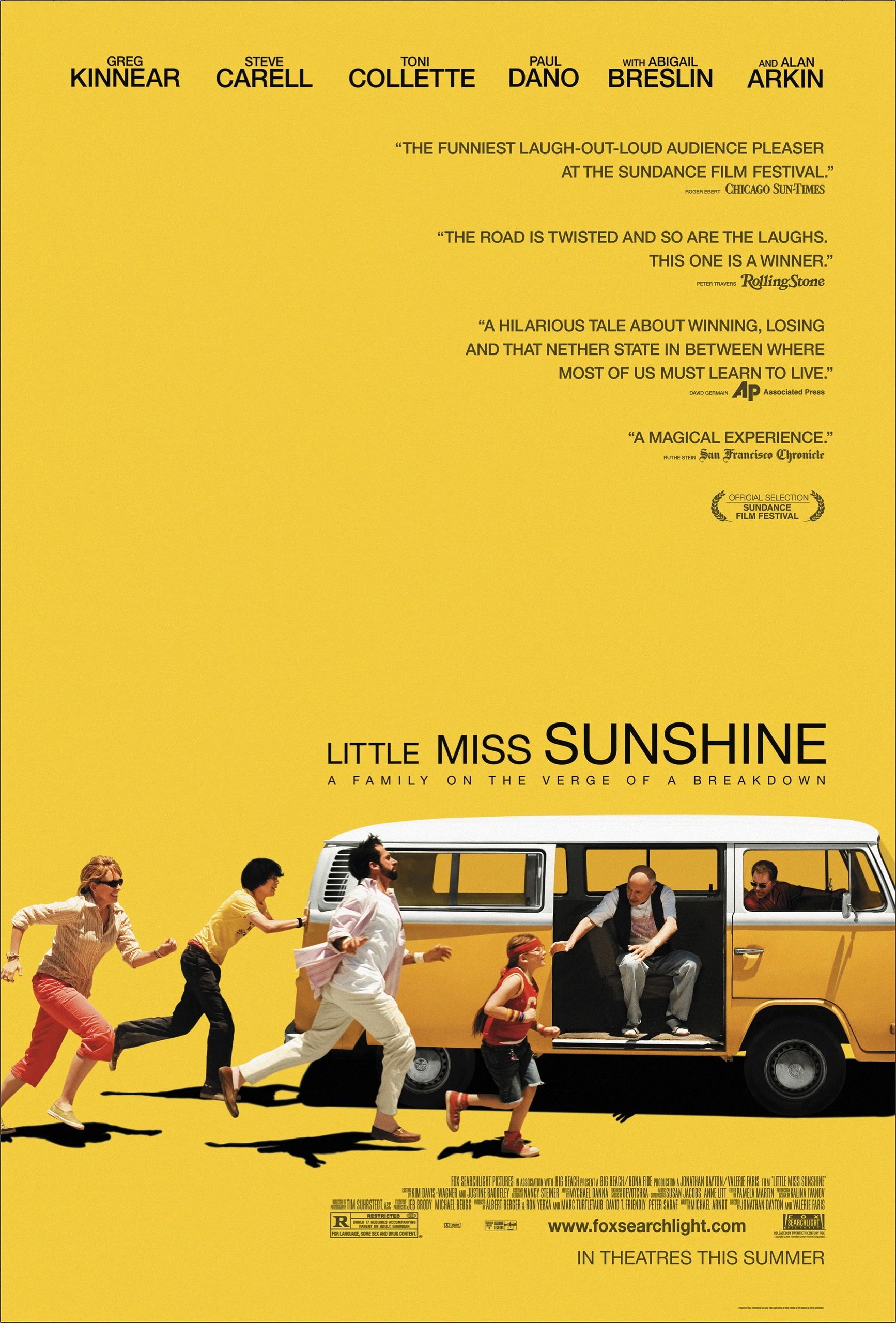
I went into Little Miss Sunshine knowing almost nothing except that people consider it one of those “feel good” indie classics. After watching it for the first time, I honestly sat back confused in the best possible way. Almost everything that happens to this family is terrible. Their situation keeps getting heavier, their problems keep piling up, and nobody gets a neat resolution at the end. Yet somehow, I walked away feeling hopeful.
I realized pretty quickly why the movie worked for me. For such a simple road trip story, the characters are sharp, vivid, and immediately recognizable. The opening minutes introduce everyone by making it crystal clear what they want most in life. Olive wants to win a pageant. Richard wants to sell his motivational program. Dwayne is locked into a goal he treats like a religion. Grandpa wants pleasure and escape. Sheryl wants to keep the family from collapsing. Frank just wants to stop hurting.
The movie gives you all this upfront, and then it throws everyone together at the dinner table. Watching them bicker, interrupt, and clash told me instantly that this wasn’t a polished sitcom family. They are a patchwork of people stuck together by circumstance. Half of them barely tolerate each other. That roughness is what makes them feel real.
The road trip isn’t about the destination at all, it is about dragging every one of these characters through situations that force them to grow. And the thing I appreciated most on my first watch is that the movie lets these characters be messy. Richard can be unbearable. Grandpa is reckless. Dwayne is hostile. Frank is drowning in grief. Even Sheryl, who tries to hold everything together, feels stretched thin. They are not softened or sanitized, and because of that, the moments where they change land harder.
Each of them hits a breaking point. Richard finally confronts the emptiness of his winners and losers philosophy. Grandpa, who showed up grumbling, becomes the emotional anchor Richard has needed. Dwayne’s silence explodes when his dream falls apart. Frank, who studies Proust, finally understands Proust’s ideas about suffering by actually living through it rather than analyzing it. Sheryl realizes she cannot protect Olive or anyone else from everything.
What surprised me was how much all of these arcs revolve around Olive. She is the youngest, but somehow she’s the character who carries the emotional weight of the story. Olive is pure hope, the version of hope that hasn’t been chipped away yet. Watching these adults rally around her, even when everything else in their lives is falling apart, made the movie feel bigger than a quirky comedy.
The pageant scene is where it all crystallized for me. Olive’s dance is chaotic, funny, and a little inappropriate, but she doesn’t know that. She’s just giving everything she has on that stage. When the pageant organizers try to stop her, every member of the family steps up. They join her, not because it fixes anything, but because protecting her joy matters more than protecting their pride.
That is where the hope comes from. By the end of the movie, their lives are not better. Richard still failed. Dwayne still can’t be a pilot. Frank’s heartbreak is still real. The family is still broke. And Grandpa is gone.
Yet they are united in a way they weren’t at the beginning. The circumstances are worse, but the characters are stronger because of each other. For the first time, they are facing life with honesty instead of delusion, connection instead of avoidance.
As a first-time viewer, that is what stuck with me most. The movie doesn’t tell you that everything will be okay. It tells you that even if everything falls apart, it helps to have people beside you who refuse to quit on you. The VW bus still breaks down, the world still disappoints, but the family keeps pushing forward anyway.
And somehow, that feels like a win.