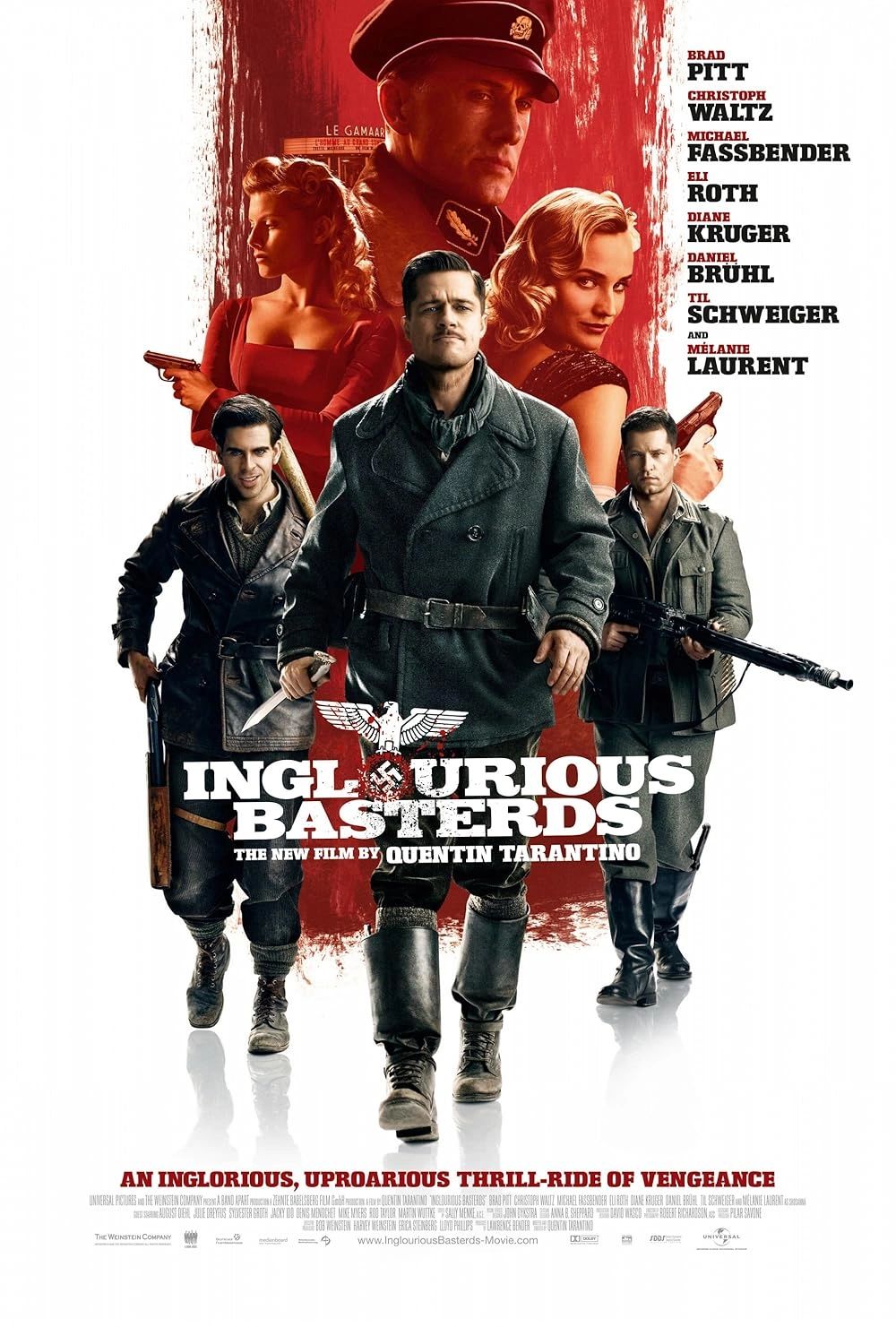
Inglourious Basterds was one of the first Tarantino films I ever watched, so I came to it without much knowledge of his broader style. I was not looking for trademarks or signatures, I was simply taking in the film for what it was. What I found was a movie that completely gripped me, especially through its use of dialogue-driven suspense. Even without being able to compare it to his other work, I could tell this was a filmmaker who built stories on his own terms.
Two scenes stood out to me above all the others. The opening farmhouse sequence immediately set the tone with its quiet menace, and the tavern scene at the midpoint cemented itself as the highlight of the movie. Both are long stretches of dialogue where not much seems to happen on the surface, yet every moment pulls you deeper into the tension until it finally bursts.
Most films follow a recognizable rhythm. The beginning introduces a question or a goal, the middle raises the stakes, and the end delivers a climax and resolution. Tarantino respects this framework, but he bends it in ways that feel unpredictable. The tavern sequence demonstrates that perfectly. At the midpoint, where tradition would place the main characters in danger, he instead builds an extended confrontation around figures we barely know. The gamble makes the scene unforgettable.
By this point in the story, we know the plan. Operation Kino is meant to assassinate the Nazi leadership at a film premiere, with the help of German actress Bridget von Hammersmark and British officer Archie Hickox, a former critic of German cinema. Their meeting should be simple. A quiet tavern in the French countryside should make for a discreet rendezvous. But the camera cuts inside and the room is already filled with German soldiers. The simple plan instantly becomes a powder keg.
What fascinates me is that the film asks us to care about characters who are not the leads. Aldo Raine, Shosanna, and Hans Landa are nowhere in sight. Instead, we spend time with Hickox, von Hammersmark, and Stiglitz. We have only just met them, yet the scene quickly reveals their personalities. Von Hammersmark remains calm and calculating, Hickox tries to lead but struggles to hold his disguise, and Stiglitz is a live wire ready to snap. Their reactions to stress tell us everything we need to know.
The sequence builds like a series of waves. First a drunken soldier interrupts, then Hickox’s accent nearly exposes him, and then a Gestapo major enters the room. The major’s authority is obvious before he even speaks. His decorated uniform, steady presence, and sharp gaze raise the tension to a new level. The dialogue turns into a contest of wits, each line probing for weakness.
The camera lingers in wide shots so we can read every reaction at the table. The game the major proposes is more than a pastime. It is a countdown to disaster. When Hickox makes a small slip, ordering three drinks with the wrong gesture, it is the proof the major needs. In a matter of seconds, guns are drawn and the tavern erupts into chaos. Nearly everyone is dead before the dust settles.
For me, this is what makes Tarantino’s scenes work. The dialogue is the fuse, and the sudden burst of violence is the explosion. One without the other would feel incomplete. The conversation creates the dread, and the payoff makes it unforgettable.
The farmhouse scene at the start of the film works in a similar but subtler way. A French farmer greets Colonel Hans Landa, who at first appears polite and friendly. Yet beneath the surface is something far more sinister. The farmer’s quiet fear and Landa’s cheerful demeanor build into a creeping sense of dread. The horror lies not in shouting or threats, but in how much Landa enjoys the torment. Where the tavern scene plays like a chess match, the farmhouse scene is psychological cruelty at its sharpest.
Looking at the film as a whole, what stays with me most is not just the execution of suspense but the audacity of the story. We all know how World War II unfolded, which is why Tarantino’s alternate history feels so bold. He turns a well-known setting into a pulp adventure that plays by his rules. Even without knowing his other films, I could tell that this was a director unafraid to reshape history and storytelling into something entirely his own.
For me, Inglourious Basterds was not just another war movie. It was my first real introduction to Tarantino, and it showed me how a filmmaker could use dialogue, structure, and risk-taking to create scenes that linger long after the credits roll. I may not know his entire body of work, but I know this: what I saw here was unforgettable.